
- Home
- Tutorial
- Resource Guides
- Focus Areas
- LSF Programs
-
Professional
Development - Review Process
-
A project of LSF


Search for Resources
It’s a Competitive Market: Finding Food, Home and a Mate
Late April 2026Top R4R Picks
Resources for extending the learning
-
Canada Goose MigrationElementary
-
Build a Bird and Bee BathElementary, Middle
-
Bursting BudsElementary
-
Migration ChallengeElementary
-
School Nest Watch Program GuideElementary, Middle, Secondary
-
Attracting and Studying HummingbirdsElementary, Middle
-
A Guide to Growing a School Butterfly GardenElementary, Middle, Secondary
-
Get to Know Migratory BirdsElementary, Middle, Secondary
-
Birds in the School YardElementary
-
The Monarch ButterflyElementary
-
-
Flutter By: Designing a Butterfly HabitatElementary, Middle
-
-
The Mystery of the Missing HummingbirdsElementary
-
Hummingbirds: Tiny But ToughMiddle, Secondary
-
Sorting through SpringElementary
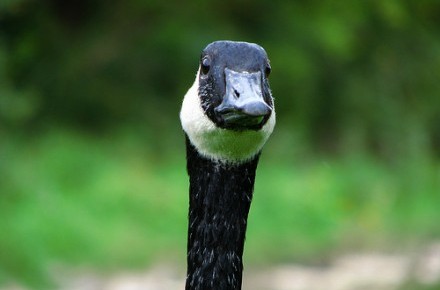
Featured species: those @#%$$%@#$&^!! geese again!
Large, high-altitude flocks of Canada Geese are passing through over the next half-month. These are mostly the Northern subspecies of the Canada Goose, Branta Canadensis interior (see Late October for a discussion of Goose subspecies).
Unlike our Giant subspecies, these birds have declined in population, only recently stabilizing at a fairly low level (roughly 100,000 birds). This has been mirrored by a rise in the population of Giants, and may be caused in part by increasing numbers of Giants flying up to James Bay to moult, and competing with the nesting Northerns and their goslings for scarce food. This has been exacerbated by the destruction of salt marsh habitat by large numbers of Snow Geese, on the increase because of heightened food production in the U.S. Midwest. Everything is connected.
Other happenings:
- Other late April arrivals include Broad-winged hawks, Chimney Swifts and Eastern Towhee, while many of the diving ducks are departing for northern breeding grounds (Common Goldeneye, Ring-necked Duck, Bufflehead, Common Merganser).
- Both Woodcock and Wilson’s (or Common) Snipe males are putting on their dramatic flight displays. Here’s a good video of Woodcock on the ground, and one of the Snipe flight with a bit of the winnowing sound created by the tail feathers. Woodcock flight sounds are here (scroll down), along with an aerial display.
Say it with a Song has students become familiar with some common birdsongs and their meanings.
- Any dragonflies that you are likely to see will be migrant Common Green Darners, pushed north on warm southern winds (if any...).
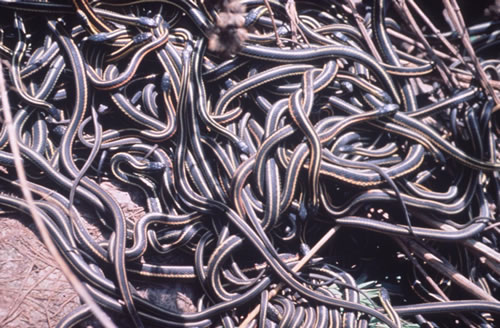
- Turtles and Eastern Garter Snakes emerge from their winter sleep. Male snakes are first on the scene, waiting for receptive females. When one appears, males fall on her in a writhing mass, but only one lucky male gets to impregnate her, leaving behind a plug of gelatine in her vent.
- In a normal year, Leopard and Pickerel (a bit later) Frogs join the amphibian chorus in nearby ponds and wetlands. Keep an ear out.
- Northern Pike move into weedy shallows and flooded marshes to spawn (at 4 – 11oC), followed soon after by Muskellunge (9 – 15oC). Both fish are easily visible by foot or canoe.
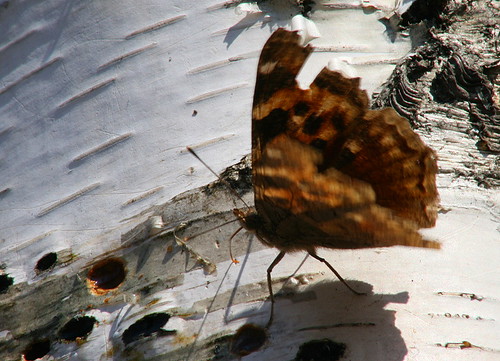
- When the thermometer breaks 15oC, keep an eye out for butterflies that have over wintered as adults, including the Mourning Cloak, Eastern Comma and Compton Tortoiseshell. With very few flowers available, these insects are attracted by tree sap, which is often provided by fresh sapsucker holes (scroll down).
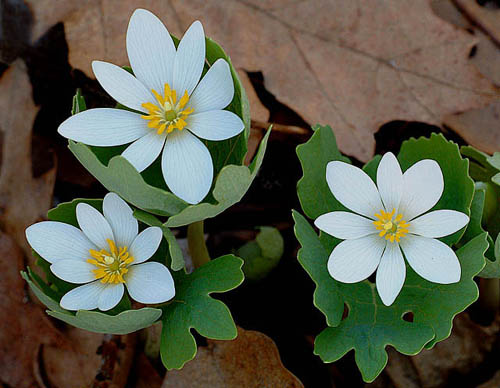
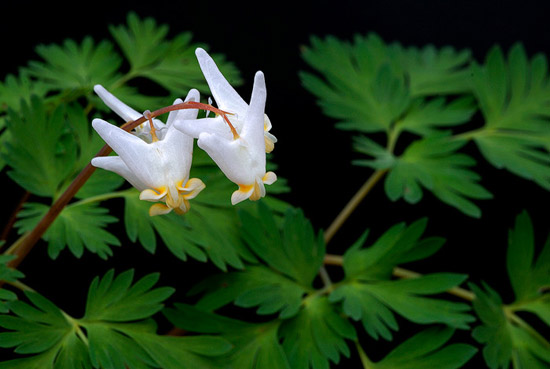
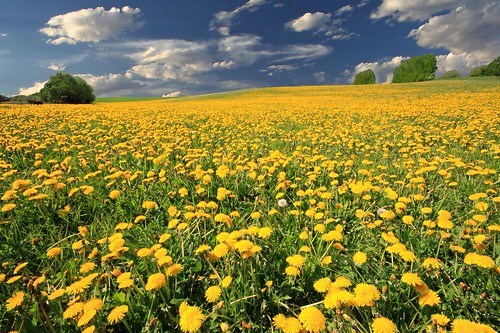
- Other flowers are joining Coltsfoot and Marsh Marigold in bloom, including Bloodroot, Spring Beauty, hepaticas, Blue Cohosh (a bit later) and Dutchman’s Breeches (also a bit later). Look for violets in gardens and early Common Dandelions.
- Just as they were the last to drop their leaves, city-bred, non-native trees are often the first to leaf out. Check the buds on Norway Maples and other introduced species. Among natives, Red-berried Elder is among the first to leaf.
Find wellness and mindfulness with time in nature, or “vitamin N”, while also learning about local trees in your backyard and their historical uses.
- Farmers are out in the fields, and if conditions are dry enough, will begin to plant hard corn, oats and spring wheat by the end of the month.
- Through mid-April, most Monarch Butterflies are steadily approaching the Mason-Dixon Line, but several have crossed over and one has made it into Hamilton, Ontario (what was it thinking?). These are mostly the butterflies that overwintered in Mexico, and are now laying eggs on fresh Milkweed plants. It’s the next generation that will push its way north to us. Get ready to report your sightings later this spring.
- This year, as of mid-April, most Ruby-throated Hummingbirds are still holding below the Mason-Dixon Line, but a few intrepid birds are creeping north. They generally arrive in southern Canada in early to mid-May (but occasionally in late April), so keep your eyes peeled and your feeders ready.
- Remember, the Lyrids meteor shower can be seen peaking to the northeast before dawn on April 22nd. It has been observed for over 2600 years, but is generally weak (10-20 meteors/hour), with occasional years of higher frequencies. The locus, or radiant (scroll down) for this shower is between the star Vega and the constellation Hercules, and points back toward the constellation Lyra. This shower is caused by the debris trail of the comet Thatcher, and is best viewed after midnight and before sunrise from the 15th through the 29th. However, you can often see the odd Lyrid meteor before midnight. The comet was named in 1861, but won’t return until 2276.
- Mercury, Mars and Saturn are grouped together just above the eastern horizon on the morning of the 20th, while the moon will be near Jupiter on the evening of the 22nd. (scroll down)