- Home
- Tutorial
- Resource Guides
- Focus Areas
- LSF Programs
-
Professional
Development - Review Process
-
A project of LSF

Search for Resources
Description
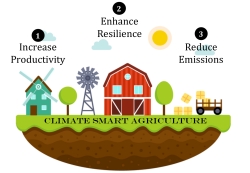
Students examine the carbon cycle, evaluate natural and human-induced activities that drive the carbon cycle, and investigate “climate smart” agricultural practices that can be used in producing our food. Using a 5E model, students will:
Engage: Students are directed to a digital magazine that explores climate change phenomena and the impacts that weather and climate have on our food supply. After the reading, students discuss what they have learned with particular attention paid to the central role of carbon.
Explore and Explain: This component of the lesson focuses on the carbon cycle and agriculture. Students work in groups to identify the resevoirs and processes that explain the movement of carbon and the difference in the environmental impact of naturally occurring vs man-made pathways A second activity focuses on climate mitigation and adaptation. Students begin by considering individual things they can do to reduce harm to the environment and how a large scale effort to support these actions can reduce the transfer of carbon to the atmosphere significantly. After watching a video describing cattle farming in Costa Rica, students list all of the efforts that were taken to mitigate greenhouse gas production. This leads to a discussion of the meaning and importance of climate smart agriculture and working in groups, students are tasked with researching one climate-smart farming practice and presenting their findings to the class.
Elaborate: Students view 3 video presentations to learn more details about carbon emissions and how climate change, agriculture and sustainability are connected.
Evaluate: Students reflect on what they have learned by identifying four key concepts in the lesson.
General Assessment
What skills does this resource explicitly teach?
While this lesson does not explicitly teach skills, students are required to synthesize & communicate information gathered from a number of different sources.
Strengths
- students and teachers will find the resource interesting and easy to use
- the activities in the Engage, and Explore sections are well-designed with clear instructions
- information is provided in a number of formats (videos, printed articles, illustrations, graphics)
- the variety of tools and strategies used to support the learning are engaging and effective
- the resource provides both teachers and students with a good deal of background information and suggestions to extend the learning.
Weaknesses
The Elaborate and Evaluate sections provide tools & information for students but lack clear direction on how they are to be used by either teacher or student.
Recommendation of how and where to use it
The range of topics the resource effectively supports makes it highly suitable for addressing sustainability in a number of curriculum areas including
- technology education (sustainable agriculture),
- science (climate change, ecosystem dynamics, environmental challenges & successes),
- geography (human impact on the environment and land use)
- social studies (contemporary & world issues)
Relevant Curriculum Units
The following tool will allow you to explore the relevant curriculum matches for this resource. To start, select a province listed below.
- Step 1Select a province
- Alberta
- Step 2Select a grade level
- Grade 10
- Step 3Select a subject
- Science
- Step 4Relevant matches
- Science 10: Energy Flow in Global Systems
- Technological Education
- Step 4Relevant matches
- AGR1100:Agriculture Technology
- Grade 11
- Step 3Select a subject
- Technological Education
- Step 4Relevant matches
- AGR2010: Diversity in Agricultue
- British Columbia
- Step 2Select a grade level
- Grade 9
- Step 3Select a subject
- Science
- Step 4Relevant matches
- Science 9: The biosphere, geosphere, hydrosphere, and atmosphere are interconnected, as matter cycles and energy flows through them.
- Grade 11
- Step 3Select a subject
- Environmental Science
- Step 4Relevant matches
- Environmental Science 11: Human practices affect the sustainability of ecosystems
- Grade 12
- Step 3Select a subject
- Environmental Science
- Step 4Relevant matches
- Environmental Science 12: Human activities cause changes in the global climate system
- Manitoba
- Step 2Select a grade level
- Grade 10
- Step 3Select a subject
- Geography
- Step 4Relevant matches
- Geographic Issues of the 21 st Century: Food from the Land
- Technological Education
- Step 4Relevant matches
- Human Ecology: Food and Nutrition - Citizenship and Sustainability
- Grade 11
- Step 3Select a subject
- Technological Education
- Step 4Relevant matches
- Human Ecology: Food and Nutrition - Citizenship and Sustainability
- Grade 12
- Step 3Select a subject
- Geography
- Step 4Relevant matches
- World Geography: A Human Perspective - World Food Supply: Production and Distribution
- New Brunswick
- Step 2Select a grade level
- Grade 12
- Step 3Select a subject
- Environmental Science
- Step 4Relevant matches
- Advanced Environmental Science 120: Earth Systems
- Introduction to Environmental Science 120: Investigating Environmental Issues
- Newfoundland & Labrador
- Northwest Territories
- Step 2Select a grade level
- Grade 9
- Step 3Select a subject
- Science
- Step 4Relevant matches
- Science 9: The biosphere, geosphere, hydrosphere, and atmosphere are interconnected, as matter cycles and energy flows through them.
- Grade 11
- Step 3Select a subject
- Environmental Science
- Step 4Relevant matches
- Environmental Science 11: Human practices affect the sustainability of ecosystems
- Grade 12
- Step 3Select a subject
- Environmental Science
- Step 4Relevant matches
- Environmental Science 12: Human activities cause changes in the global climate system
- Nova Scotia
- Step 2Select a grade level
- Grade 8
- Step 3Select a subject
- Science
- Step 4Relevant matches
- Science 8: Climate Change
- Grade 10
- Step 3Select a subject
- Science
- Step 4Relevant matches
- Science 10: Sustainability of Ecosystems
- Grade 12
- Step 3Select a subject
- Geography
- Step 4Relevant matches
- AP Human Geography: Agricultural and Rural Land - Use Patterns and Processes
- Nunavut
- Ontario
- Step 2Select a grade level
- Grade 9
- Step 3Select a subject
- Science
- Step 4Relevant matches
- :Biology: Sustainable Ecosystems
- Grade 10
- Step 3Select a subject
- Science
- Step 4Relevant matches
- Science (Academic):Earth and Space Science: Climate Change
- Grade 11
- Step 3Select a subject
- Environmental Science
- Step 4Relevant matches
- Environmental Science (Univ/College Prep.) Sustainable Agriculture and Forestry
- Grade 12
- Step 3Select a subject
- Geography
- Step 4Relevant matches
- Living in a Sustainable World (Workplace Prep.) Ecosystems and Human Activity
- The Environment & Resource Management (Univ./College Prep) : Ecological Systems: Interactions and Interdependence
- Prince Edward Island
- Step 2Select a grade level
- Grade 10
- Step 3Select a subject
- Science
- Step 4Relevant matches
- Science 431A: Life Science, Sustainability of Ecosystems
- Grade 12
- Step 3Select a subject
- Environmental Science
- Step 4Relevant matches
- Environmental Science 621A: Ecological Principles
- Environmental Science 621A: Environmental Challenges and Successes
- Science
- Step 4Relevant matches
- Agriscience 801A: Overview
- Quebec
- Step 2Select a grade level
- Grade 9
- Step 3Select a subject
- Social Studies
- Step 4Relevant matches
- The Contemporary World: Environment
- Grade 10
- Step 3Select a subject
- Science & Technology
- Step 4Relevant matches
- Applied Science & Technology:The Living World
- Environmental Science & Technology: The Earth and Space
- Science & Technology: The Earth and Space
- Science and the Environment: The Earth and Space
- Grade 11
- Step 3Select a subject
- Social Studies
- Step 4Relevant matches
- Contemporary World: Environment
- Saskatchewan
- Yukon Territory
- Step 2Select a grade level
- Grade 9
- Step 3Select a subject
- Science
- Step 4Relevant matches
- Science 9: The biosphere, geosphere, hydrosphere, and atmosphere are interconnected, as matter cycles and energy flows through them.
- Grade 11
- Step 3Select a subject
- Environmental Science
- Step 4Relevant matches
- Environmental Science 11: Human practices affect the sustainability of ecosystems
- Grade 12
- Step 3Select a subject
- Environmental Science
- Step 4Relevant matches
- Environmental Science 12: Human activities cause changes in the global climate system
Themes Addressed
Air, Atmosphere & Climate (2)
- Climate Change
- Weather
Food & Agriculture (3)
- Biotechnology
- Food Security
- Pesticides
Sustainability Education Principles
| Principle | Rating | Explanation |
|---|---|---|
| Consideration of Alternative Perspectives | Very Good | In their exploration of the relationship between agriculture and climate change, students review science concepts, principles, research data, and recent case studies. It is the validity and evidence-based nature of this information that allows them to be informed. |
Consideration of Alternative Perspectives:
| ||
| Multiple Dimensions of Problems & Solutions | Good | The video describing farming in Costa Rica provides a case study in sustainability and in this case, sustainable agriculture. It does a very good job providing examples of how climate smart farming practices not only help the planet, but make good economic sense as well. |
| Multiple Dimensions of Problems & Solutions: Effectively addresses the environmental, economic and social dimensions of the issue(s) being explored.
| ||
| Respects Complexity | Very Good | The engagement section of the lesson introduces the idea of carbon as the key factor when discussing climate and climate change. The remaining lesson components present students with the complexities involved, from the carbon cycle to greenhouse gas production and role of agriculture in both contributing to and mitigating climate change. |
| Respects Complexity: The complexity of the problems/issues being discussed is respected. | ||
| Acting on Learning | Poor/Not considered | Student action is not a component of this lesson. The objectives are student awareness and understanding. |
| Acting on Learning: Learning moves from understanding issues to working towards positive change — in personal lifestyle, in school, in the community, or for the planet
| ||
| Values Education | Poor/Not considered | As students complete readings, activities and investigations, they are consistently provided with time (and are directed) to "brainstorm their thoughts and ideas" |
| Values Education: Students are explicitly provided with opportunities to identify, clarify and express their own beliefs/values. | ||
| Empathy & Respect for Humans | Poor/Not considered | |
| Empathy & Respect for Humans: Empathy and respect are fostered for diverse groups of humans (including different genders, ethnic groups, sexual preferences, etc.). | ||
| Personal Affinity with Earth | Good | The seriousness of climate impacts and the need for mitigation are made clear to the students. And, as they examine and report on climate smart agriculture, attention is directed to how it helps protect soil, forests, water and air and why this is so important. |
| Personal Affinity with Earth: Encourages a personal affinity with -the natural world.
| ||
| Locally-Focused Learning | Poor/Not considered | All students should be aware of climate change and most have experienced extreme weather events in their own lives. The discussion of climate change impacts, mitigation, adaptation and the role of agriculture will add meaning to these experiences. |
| Locally-Focused Learning: Includes learning experiences that take advantage of issues/elements within the local community.
| ||
| Past, Present & Future | Poor/Not considered | The "science of climate change" video shows students how scientists have used ice core samples to identify CO2 concentrations and atmospheric temperatures going back millions of years. The correlation between them has allowed climate researchers to identify greenhouse gases as the driver of climate change in the past and present and will continue to do so in the future. |
| Past, Present & Future: Promotes an understanding of the past, a sense of the present, and a positive vision for the future. | ||
Pedagogical Approaches
| Principle | Rating | Explanation |
|---|---|---|
| Open-Ended Instruction | Very Good | The information students use to answer questions and build knowledge around carbon, climate change and climate smart agriculture is provided in the form of evidence-based science and current case studies. |
| Open-Ended Instruction
: Lessons are structured so that multiple/complex answers are possible; students are not steered toward one 'right' answer. | ||
| Integrated Learning | Very Good | The role of climate smart agriculture in mitigating and adapting to climate change is addressed in the context of sustainabilty and therefor addresses content not just found in Science (carbon cycle, ecosystem concept, climate change) but other subject areas as well, including Environmental science, Environmental Studies, World Issues, Geography and Technology (agriculture). |
| Integrated Learning: Learning brings together content and skills from more than one subject area
| ||
| Inquiry Learning | Satisfactory | Students are provided with questions and information from a variety of sources which they then review, discuss amongst their peers and propose answers. |
| Inquiry Learning: Learning is directed by questions, problems, or challenges that students work to address.
| ||
| Differentiated Instruction | Satisfactory | Much of the learning involves answering specific questions after reading, listening to or viewing information. There are also activities that involve manipulatives (to support the text and illustrations in understanding the carbon cycle) and an opportunity to research, prepare and deliver a presentation. Students work individually and in both small and large groups. Discussion is encouraged throughout. |
| Differentiated Instruction: Activities address a range of student learning styles, abilities and readiness.
| ||
| Experiential Learning | Satisfactory | Some students will find the use of manipulatives and two-dimensional model making helpful in understanding the carbon cycle. |
| Experiential Learning: Authentic learning experiences are provided
| ||
| Cooperative Learning | Satisfactory | While students work in both small and large groups, cooperative learning skills are not explicitly taught or practiced. |
| Cooperative Learning: Group and cooperative learning strategies are a priority.
| ||
| Assessment & Evaluation | Satisfactory | Rubrics or specific tools are not inlcuded. However the inclusion of discussion questions provides opportunities for assesment throught the lesson. Student also complete paper and pencil exercises and present research findings to the class. |
| Assessment & Evaluation: Tools are provided that help students and teachers to capture formative and summative information about students' learning and performance. These tools may include reflection questions, checklists, rubrics, etc. | ||
| Peer Teaching | Poor/Not considered | The grouping of students to investigate and discuss and eventually to present to the class will involve interacting with and learning from other students. |
| Peer Teaching: Provides opportunities for students to actively present their knowledge and skills to peers and/or act as teachers and mentors.
| ||
| Case Studies | Very Good | The video "Happy Cows Save the Planet" is an excellent case study that provides the key description for students of the meaning and impacts of climate smart agriculture. |
| Case Studies: Relevant case studies are included. Case studies are thorough descriptions of real events from real situations that students use to explore concepts in an authentic context. | ||
| Locus of Control | Satisfactory | These opportunities are limited. The class can collectively choose a format for their climate smart practice presentations. |
| Locus of Control: Meaningful opportunities are provided for students to choose elements of program content, the medium in which they wish to work, and/or to go deeper into a chosen issue. | ||