- Home
- Tutorial
- Resource Guides
- Focus Areas
- LSF Programs
-
Professional
Development - Review Process
-
A project of LSF

Search for Resources
Description
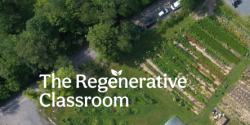
In this lesson plan, students explore key concepts of regeneration through the lenses of Indigenous scholars, activists, and farmers. They learn how traditional Indigenous farming practices take a more holistic approach, emphasizing the deep connection between humans and the natural world and focusing on caring for the land across generations. Students then create a story inspired by how indigenous farming knowledge was traditionally passed down through storytelling, that conveys different perspectives on the human relationship with nature and animals.
Students will:
- watch a clip from the film Kiss the Ground that shows how Indigenous Native American cultures have practiced regenerative ways of caring for the land
- read the” The Lakota Emergence Story” to learn how storytelling is central to how culture, history and religion are passed down through generations and discuss answers to suggested questions
- brainstorm ideas ways to teach other students or their families about regeneration. The story can take any form, written, drawn like a comic book, like a play, podcast, or other creative idea
- share their stories with one another, and make plans to share with other classes, or at home with their families
Teachers have access to the educational version of the film needed for this lesson. The link to the free download is provided on the website. An alternate video on regeneration is also suggested.
General Assessment
Strengths
- Topic is current and lesson plan is easy to use
- Highlights Indigenous perspectives and knowledge, helping students understand different relationships with the land
- Supports a variety of different learning styles
Weaknesses
- No outdoor activity or action project is suggested
- No assessment tools or rubrics are provided
- Does not include a case study of a specific Indigenous community or farming practice
Recommendation of how and where to use it
This lesson supports curriculum outcomes for students in grades four to eight in science, social studies, language arts and visual arts.
Relevant Curriculum Units
The following tool will allow you to explore the relevant curriculum matches for this resource. To start, select a province listed below.
- Step 1Select a province
- Alberta
- Step 2Select a grade level
- Grade 4
- Step 3Select a subject
- Science
- Step 4Relevant matches
- Earth Systems: Understandings of the living world, Earth, and space are deepened through investigating natural systems and their interactions.
- Grade 6
- Step 3Select a subject
- Science
- Step 4Relevant matches
- Living Systems: Understandings of the living world, Earth, and space are deepened through investigating natural systems and their interactions
- Grade 7
- Step 3Select a subject
- Science
- Step 4Relevant matches
- Interactions and Ecosystems
- Plants for Food and Fibre
- British Columbia
- Manitoba
- Step 2Select a grade level
- Grade 4
- Step 3Select a subject
- Indigenous Languages and Cultures
- Step 4Relevant matches
- Cultural and Linguistic Diversity: Other Cultures: Connections and Influences
- Cultural and Linguistic Diversity: Specific Aboriginal Culture
- Social Studies
- Step 4Relevant matches
- Manitoba, Canada, and the North: Places and Stories: Living in Manitoba
- Grade 5
- Step 3Select a subject
- Social Studies
- Step 4Relevant matches
- Peoples and Stories of Canada to 1867: First Peoples
- Grade 7
- Step 3Select a subject
- Science
- Step 4Relevant matches
- Indigenous Peoples Within the Natural World
- Life Systems
- New Brunswick
- Newfoundland & Labrador
- Northwest Territories
- Nova Scotia
- Nunavut
- Ontario
- Step 2Select a grade level
- Grade 6
- Step 3Select a subject
- Science & Technology
- Step 4Relevant matches
- Life Systems: Biodiversity
- Grade 7
- Step 3Select a subject
- Science & Technology
- Step 4Relevant matches
- Life Systems: Interactions in the Environment
- Prince Edward Island
- Quebec
- Step 2Select a grade level
- Grade 5
- Step 3Select a subject
- Science & Technology
- Step 4Relevant matches
- Living Things
- Grade 6
- Step 3Select a subject
- Science & Technology
- Step 4Relevant matches
- Living Things
- Saskatchewan
- Yukon Territory
Themes Addressed
Air, Atmosphere & Climate (1)
- Climate Change
Food & Agriculture (2)
- Conventional Farming
- Organic Farming
Indigenous Knowledge (2)
- Rituals, Spirituality and Worldviews
- TEK -- Traditional Ecological Knowledge
Sustainability Education Principles
| Principle | Rating | Explanation |
|---|---|---|
| Consideration of Alternative Perspectives | Good | The suggested videos explore different perspectives on regeneration and how humans relate to nature. It highlights Indigenous views that focus on respecting the land and seeing humans as part of nature with a responsibility to care for it. This differs from modern industrial agriculture, which often focuses more on producing food efficiently. |
Consideration of Alternative Perspectives:
| ||
| Multiple Dimensions of Problems & Solutions | Good | The resource addresses the environmental, economic, and social aspects of regeneration. It shows how regenerative practices restore ecosystems, support sustainable farming, and emphasize community and Indigenous connections to the land. |
| Multiple Dimensions of Problems & Solutions: Effectively addresses the environmental, economic and social dimensions of the issue(s) being explored.
| ||
| Respects Complexity | Good | Regenerative agriculture aims to maintain soil health, biodiversity, and balanced ecosystems over time. In contrast, modern industrial agriculture often prioritizes efficiency and high yields, which can sometimes lead to soil degradation, loss of biodiversity, and other environmental impacts. |
| Respects Complexity: The complexity of the problems/issues being discussed is respected. | ||
| Acting on Learning | Poor/Not considered | No action opportunities are suggested. |
| Acting on Learning: Learning moves from understanding issues to working towards positive change — in personal lifestyle, in school, in the community, or for the planet
| ||
| Values Education | Good | Students answer discussion questions after viewing the videos. They also brainstorm ideas on how to teach other students or their families about regeneration. |
| Values Education: Students are explicitly provided with opportunities to identify, clarify and express their own beliefs/values. | ||
| Empathy & Respect for Humans | Good | The lesson focuses on Indigenous Peoples’ perspectives on regeneration and land stewardship, which emphasizes the relationship between humans and nature. |
| Empathy & Respect for Humans: Empathy and respect are fostered for diverse groups of humans (including different genders, ethnic groups, sexual preferences, etc.). | ||
| Personal Affinity with Earth | Good | The lesson plan connects to the natural world as it explores Indigenous relationships with the land, sustainable farming practices, and the idea that humans must live in balance with nature. It teaches that Indigenous farming practices view humans as part of the natural world, with a responsibility to care for the land, soil, plants, and animals. |
| Personal Affinity with Earth: Encourages a personal affinity with -the natural world.
| ||
| Locally-Focused Learning | Good | Students examine real-world issues like food production, and soil health, which affect everyone’s food and environment. |
| Locally-Focused Learning: Includes learning experiences that take advantage of issues/elements within the local community.
| ||
| Past, Present & Future | Good | The activities teach students about traditional Indigenous farming practices from the past, connects them to environmental issues today, and shows how these ideas can help create a more sustainable future. |
| Past, Present & Future: Promotes an understanding of the past, a sense of the present, and a positive vision for the future. | ||
Pedagogical Approaches
| Principle | Rating | Explanation |
|---|---|---|
| Open-Ended Instruction | Very Good | Students create a story as a tool to teach others about regeneration. The story can take any form, written, drawn like a comic book, like a play, podcast, or other creative idea. |
| Open-Ended Instruction
: Lessons are structured so that multiple/complex answers are possible; students are not steered toward one 'right' answer. | ||
| Integrated Learning | Good |
|
| Integrated Learning: Learning brings together content and skills from more than one subject area
| ||
| Inquiry Learning | Good | Students are asked to think about different perspectives on the relationship between humans and nature and to explore how Indigenous farming practices support regeneration. They also create a story based on how Indigenous knowledge was traditionally passed down, which encourages them to reflect, ask questions, and develop their own understanding of the topic. |
| Inquiry Learning: Learning is directed by questions, problems, or challenges that students work to address.
| ||
| Differentiated Instruction | Very Good | The lesson plan addresses the needs of visual, aurditory and kinesthetic learners. Students watch a video (visual and auditory), listen to explanations and storytelling (auditory), and participate in activities such as creating their own story or presentation (kinesthetic). |
| Differentiated Instruction: Activities address a range of student learning styles, abilities and readiness.
| ||
| Experiential Learning | Poor/Not considered | No outdoor experience or activity is provided in this lesson plan. |
| Experiential Learning: Authentic learning experiences are provided
| ||
| Cooperative Learning | Satisfactory | In the small groups, students brainstorm ideas on how to teach other students or their families about regeneration. |
| Cooperative Learning: Group and cooperative learning strategies are a priority.
| ||
| Assessment & Evaluation | Poor/Not considered | No assessment tools or rubrics are provided. |
| Assessment & Evaluation: Tools are provided that help students and teachers to capture formative and summative information about students' learning and performance. These tools may include reflection questions, checklists, rubrics, etc. | ||
| Peer Teaching | Good | Students share their stories with one another, and make plans to share with other classes, or at home with their families. |
| Peer Teaching: Provides opportunities for students to actively present their knowledge and skills to peers and/or act as teachers and mentors.
| ||
| Case Studies | Satisfactory | The lesson does not have a detailed case study section, but it includes a film clip and video that acts like a case studies of Indigenous knowledge and regeneration. |
| Case Studies: Relevant case studies are included. Case studies are thorough descriptions of real events from real situations that students use to explore concepts in an authentic context. | ||
| Locus of Control | Good | Students brainstorm ideas on how to teach other students or their families about regeneration. The |
| Locus of Control: Meaningful opportunities are provided for students to choose elements of program content, the medium in which they wish to work, and/or to go deeper into a chosen issue. | ||