- Home
- Tutorial
- Resource Guides
- Focus Areas
- LSF Programs
-
Professional
Development - Review Process
-
A project of LSF

Search for Resources
How to be flood smart- Gr. 5-8
Sharing information through public service announcements
Elementary, Middle
Description
How to be flood smart focuses on the questions
- How can we prepare and respond to a flood?
- What are the key aspects about flooding that everyone should know?
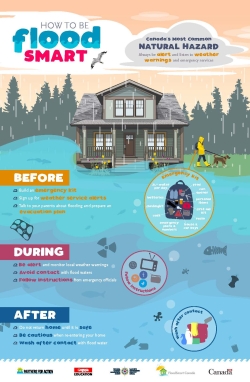
The lesson begins by activating prior knowledge of natural disasters in a class-wide discussion.Then students are divided into groups to read and view a FloodSmart Canada infographic. They complete the questions on the provided worksheet and share their responses with the class.
Armed with this new knowledge, the students create a one-minute PSA that describes the risks associated with flooding in addition to what should be done before, during and after a flood. The PSAs are shared with the class once they are completed.
General Assessment
What skills does this resource explicitly teach?
This resource concentrates on developing an awareness of the steps to prepare for flooding in the community. It does not explicitly teach a skill.
Strengths
- Quality activities that are engaging and address a variety of learning styles
- Plenty of extension ideas to support the lesson
- All materials are included and external links are active and up to date.
Weaknesses
- No assessment tools are provided, although assessment suggestions are made.
Recommendation of how and where to use it
This resource is best suited for the middle school Science classroom. It helps to address outcomes related to human impacts on the environment and Earth's water systems in Science as well as those related to emergency preparedness and safety in Health and Social Studies units.
Relevant Curriculum Units
The following tool will allow you to explore the relevant curriculum matches for this resource. To start, select a province listed below.
- Step 1Select a province
- Alberta
- Step 2Select a grade level
- Grade 5
- Step 3Select a subject
- Science
- Step 4Relevant matches
- Earth Systems: Understandings of the living world, Earth, and space are deepened by investigating natural systems and their interactions.
- Social Studies
- Step 4Relevant matches
- Citizenship: Understanding local, national, and global issues empowers individual and collective action toward an inclusive society
- Grade 6
- Step 3Select a subject
- Science
- Step 4Relevant matches
- Earth Systems: Understandings of the living world, Earth, and space are deepened through investigating natural systems and their interactions.
- Social Studies
- Step 4Relevant matches
- Citizenship: Understanding local, national, and global issues empowers individual and collective action toward an inclusive society
- Grade 8
- Step 3Select a subject
- Science
- Step 4Relevant matches
- Freshwater and Saltwater Systems
- Newfoundland & Labrador
- Step 2Select a grade level
- Grade 5
- Step 3Select a subject
- Science
- Step 4Relevant matches
- Weather
- Grade 6
- Step 3Select a subject
- Health Education
- Step 4Relevant matches
- Health: Environmental Health
- Health: Injury Prevention and Safety
- Social Studies
- Step 4Relevant matches
- How Can We Be Good Global Citizens?
- Grade 7
- Step 3Select a subject
- Health Education
- Step 4Relevant matches
- Health: Safety and Environmental Health
- Grade 8
- Step 3Select a subject
- Science
- Step 4Relevant matches
- Water Systems on Earth's Surface
- Northwest Territories
- Step 2Select a grade level
- Grade 6
- Step 3Select a subject
- Health Education
- Step 4Relevant matches
- Health: Healthy choices influence our physical, emotional, and mental well-being as an NWT capable person
- Grade 7
- Step 3Select a subject
- Health Education
- Step 4Relevant matches
- Health: Healthy choices influence our physical, emotional, mental and spiritual well-being
- Grade 8
- Step 3Select a subject
- Health Education
- Step 4Relevant matches
- Health: Healthy choices influence our physical, emotional, spiritual, and mental well-being
- Nova Scotia
- Nunavut
- Ontario
- Step 2Select a grade level
- Grade 8
- Step 3Select a subject
- Science & Technology
- Step 4Relevant matches
- Earth and Space Systems: Water Systems
- Prince Edward Island
- Step 2Select a grade level
- Grade 5
- Step 3Select a subject
- Health Education
- Step 4Relevant matches
- Wellness Choices
- Science
- Step 4Relevant matches
- Weather
- Grade 6
- Step 3Select a subject
- Health Education
- Step 4Relevant matches
- Wellness Choices
- Grade 8
- Step 3Select a subject
- Science
- Step 4Relevant matches
- Water Systems on Earth
- Quebec
- Step 2Select a grade level
- Grade 5
- Step 3Select a subject
- Science & Technology
- Step 4Relevant matches
- Living Things
- Saskatchewan
- Step 2Select a grade level
- Grade 5
- Step 3Select a subject
- Science
- Step 4Relevant matches
- Weather
- Grade 6
- Step 3Select a subject
- Health Education
- Step 4Relevant matches
- Health Education 6: Understanding, Skills and Confidences
- Grade 8
- Step 3Select a subject
- Science
- Step 4Relevant matches
- Science 8: Water Systems on Earth
Themes Addressed
Citizenship (1)
- General Guide to Taking Action
Sustainability Education Principles
| Principle | Rating | Explanation |
|---|---|---|
| Consideration of Alternative Perspectives | Good | This resource is structured as an instructional guide to develop an awareness of the risks, safety concerns and needed responses associated with flooding. It does not offer alternative perspectives on the issue as this is not the purpose of the resource. |
Consideration of Alternative Perspectives:
| ||
| Multiple Dimensions of Problems & Solutions | Poor/Not considered | The resource has a strong focus on the environmental impacts of flooding by discussing flood patterns, weather conditions and natural hazards. The social dimension is partially addressed by discussing safety and emergency preparedness and risk awareness but it does not address broader social issues like vulnerable populations, etc. The economic dimensions of the issue are not really addressed. Topics like insurance costs, repair costs or disaster relief funding are not part of this resource. |
| Multiple Dimensions of Problems & Solutions: Effectively addresses the environmental, economic and social dimensions of the issue(s) being explored.
| ||
| Respects Complexity | Very Good | |
| Respects Complexity: The complexity of the problems/issues being discussed is respected. | ||
| Acting on Learning | Satisfactory | In the extension activities, the students are encouraged to build an emergency kit with their families as well as to learn about evacuation routes in their communities. |
| Acting on Learning: Learning moves from understanding issues to working towards positive change — in personal lifestyle, in school, in the community, or for the planet
| ||
| Values Education | Good | Values such as civic responsibility, community action, and empathy are addressed though its focus is more on practical safety. |
| Values Education: Students are explicitly provided with opportunities to identify, clarify and express their own beliefs/values. | ||
| Empathy & Respect for Humans | Poor/Not considered | This is not a focus of this resource. |
| Empathy & Respect for Humans: Empathy and respect are fostered for diverse groups of humans (including different genders, ethnic groups, sexual preferences, etc.). | ||
| Personal Affinity with Earth | Satisfactory | Students develop a connection to the natural world via a concern from flooding risks. |
| Personal Affinity with Earth: Encourages a personal affinity with -the natural world.
| ||
| Locally-Focused Learning | Good | As flooding can occur in most communities, the learning can be applied to the communities in which the students reside. |
| Locally-Focused Learning: Includes learning experiences that take advantage of issues/elements within the local community.
| ||
| Past, Present & Future | Good | With its emphasis on preparedness, the resource creates a sense of positivity for the future. A sense of the present is in the practicality of flooding as a common risk in any community. The resource does not address the past. This is not a detraction from the quality of the resource. |
| Past, Present & Future: Promotes an understanding of the past, a sense of the present, and a positive vision for the future. | ||
Pedagogical Approaches
| Principle | Rating | Explanation |
|---|---|---|
| Open-Ended Instruction | Very Good | This resource is structured in a manner in which students are learning and gathering information that will be shared via a PSA. Students participate in activities that are open-ended. |
| Open-Ended Instruction
: Lessons are structured so that multiple/complex answers are possible; students are not steered toward one 'right' answer. | ||
| Integrated Learning | Good |
|
| Integrated Learning: Learning brings together content and skills from more than one subject area
| ||
| Inquiry Learning | Satisfactory | The materials provided in the resource encourage students to ask questions, interpret geographical trends, and apply concepts to their local communities rather than just memorizing facts. |
| Inquiry Learning: Learning is directed by questions, problems, or challenges that students work to address.
| ||
| Differentiated Instruction | Good | Through a variety of activities, the different learning styles of students are addressed. Visual learners are supported via the visual media that is included while the auditory learners are connected via class discussion prompts. The kinesthetic learners will enjoy the hands-on PSA creation. |
| Differentiated Instruction: Activities address a range of student learning styles, abilities and readiness.
| ||
| Experiential Learning | Satisfactory | The learning occurs via observations and reflections on the infographic and then presenting and sharing of the PSA. |
| Experiential Learning: Authentic learning experiences are provided
| ||
| Cooperative Learning | Satisfactory | Group work is the primary learning environment in this resource. |
| Cooperative Learning: Group and cooperative learning strategies are a priority.
| ||
| Assessment & Evaluation | Good | There are some suggestions for the assessment of learning. There are no tools such as rubrics or checklists provided. |
| Assessment & Evaluation: Tools are provided that help students and teachers to capture formative and summative information about students' learning and performance. These tools may include reflection questions, checklists, rubrics, etc. | ||
| Peer Teaching | Satisfactory | Students will learn from each other via their PSA presentations. |
| Peer Teaching: Provides opportunities for students to actively present their knowledge and skills to peers and/or act as teachers and mentors.
| ||
| Case Studies | Poor/Not considered | These are not included in the resource. |
| Case Studies: Relevant case studies are included. Case studies are thorough descriptions of real events from real situations that students use to explore concepts in an authentic context. | ||
| Locus of Control | Good | Students have a large amount of choice regarding how they organize and present their work, but limited control regarding the topic and required content. |
| Locus of Control: Meaningful opportunities are provided for students to choose elements of program content, the medium in which they wish to work, and/or to go deeper into a chosen issue. | ||