- Home
- Tutorial
- Resource Guides
- Focus Areas
- LSF Programs
-
Professional
Development - Review Process
-
A project of LSF
Search for Resources
Description
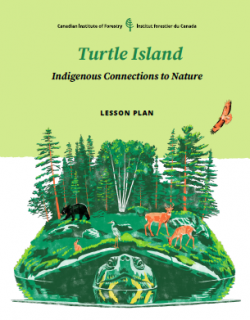
Turtle Island: Indigenous Connections to Nature is a lesson plan in which students explore nature by focusing on species native to Eastern Ontario and their cultural significance to local Indigenous communities. The activity involves outdoor exploration in the schoolyard, on a walk, or during a visit to a nearby urban or rural forested area.
Students develop knowledge and understanding of native mammals, plants, trees, and other species, including their habitats and the actions needed to support their preservation within the landscape. The lesson emphasizes Indigenous cultural perspectives, such as creation stories, interconnectedness, and the respectful use of natural species in daily life. Through this experience, students build skills in species identification, deepen their understanding of ecosystem relationships, and recognize the cultural importance of local biodiversity, fostering a sense of stewardship for the land and its inhabitants.
The lesson plan includes several structured steps:
Step 1: Introduce the Turtle Island Creation Story to highlight its significance across Indigenous cultures in Canada and to emphasize the deep relationship between people, the land, and the environment, where the natural world is viewed as home and all beings have an important role.
Step 2: Discuss the use of natural materials from the environment and connect these practices to modern activities such as gardening and food sourcing. Introduce the concept of stewardship, emphasizing responsible interaction with nature by taking only what is needed, gathering sustainably, and respecting other living beings.
Step 3: Introduce students to the Species of Eastern Ontario Catalogue, from the resource, guiding them through the different species categories, highlighting their images, habitats, and cultural significance.
Step 4: Use the turtle shell model provided in the appendix to represent different native species categories. Students work in teams to collect related items and then reconstruct the turtle shell together to demonstrate the interconnectedness of all living things.
Step 5: Take students to an outdoor space—preferably a forested area when possible—and organize them into groups based on selected turtle shell species categories. Provide clear guidance and time for students to explore the area and search for related items.
The Turtle Island: Indigenous Connections to Nature lesson, originally for species native to Eastern Ontario, can be adapted for other provinces by using local species, ecosystems, and Indigenous knowledge, while keeping its core activities and focus on nature, culture, and environmental stewardship.
General Assessment
Strengths
- Activities are flexible and easy to follow
- Supplementary high-quality print, videos, and web-based resources that would augment lessons and activities are also included
- The lesson plan is available in English and French and can be downloaded for free
- These outcomes can be easily adapted/expanded to fit specific curriculum needs
- Includes links to websites for either your needs or your students’ research
- Variety of different activities to engage students with a variety of learning styles.
- Excellent outdoor component is provided
Weaknesses
- No formal assessment tools are provided
- No authentic action experience in the resource
- No accommodation or modifications suggested for struggling learners
Recommendation of how and where to use it
This lesson plan has been developed in collaboration with the Eastern Ontario Model Forest and highlights species that hold cultural importance for the Indigenous Peoples of the region. The resource offers a range of extension activities to deepen learning and recommends additional Turtle Island videos and books to further support students’ understanding.
This lesson can be used in classrooms, outdoor education programs, or youth workshops to engage students with nature and Indigenous knowledge. It is well suited for grades three to six science or social studies units, and can be integrated into field trips, school gardens, or local parks to provide hands-on learning experiences that connect students to their local environment and Indigenous cultural perspectives.
Relevant Curriculum Units
The following tool will allow you to explore the relevant curriculum matches for this resource. To start, select a province listed below.
- Step 1Select a province
- Alberta
- Step 2Select a grade level
- Grade 3
- Step 3Select a subject
- Science
- Step 4Relevant matches
- Living Systems: Understandings of the living world, Earth, and space are deepened through investigating natural systems and their interactions
- Grade 4
- Step 3Select a subject
- Science
- Step 4Relevant matches
- Earth Systems: Understandings of the living world, Earth, and space are deepened through investigating natural systems and their interactions.
- Grade 6
- Step 3Select a subject
- Science
- Step 4Relevant matches
- Living Systems: Understandings of the living world, Earth, and space are deepened through investigating natural systems and their interactions
- British Columbia
- Step 2Select a grade level
- Grade 3
- Step 3Select a subject
- Science
- Step 4Relevant matches
- Science 3: Living things are diverse, can be grouped, and interact in their ecosystems
- Social Studies
- Step 4Relevant matches
- Global Indigenous Peoples: Learning about indigenous peoples nurtures multicultural awareness and respect for diversity.
- Global Indigenous Peoples: Indigenous knowledge is passed down through oral history, traditions, and collective memory.
- Global Indigenous Peoples:Indigenous societies throughout the world value the well-being of the self, the land, spirits, and ancestors
- Grade 4
- Step 3Select a subject
- Science
- Step 4Relevant matches
- Science 4: All living things sense and respond to their environment
- Manitoba
- Step 2Select a grade level
- Grade 3
- Step 3Select a subject
- Indigenous Languages and Cultures
- Step 4Relevant matches
- Cultural and Linguistic Diversity: Other Cultures: Connections and Influences
- Cultural and Linguistic Diversity: Specific Aboriginal Culture
- Science
- Step 4Relevant matches
- Growth and Changes in Plants
- Life Science
- Grade 4
- Step 3Select a subject
- Indigenous Languages and Cultures
- Step 4Relevant matches
- Cultural and Linguistic Diversity: Other Cultures: Connections and Influences
- Cultural and Linguistic Diversity: Specific Aboriginal Culture
- Science
- Step 4Relevant matches
- Habitat and Communities
- Life Systems
- Grade 6
- Step 3Select a subject
- Indigenous Languages and Cultures
- Step 4Relevant matches
- Cultural and Linguistic Diversity: Other Cultures: Connections and Influences
- Science
- Step 4Relevant matches
- Diversity of Living Things
- New Brunswick
- Newfoundland & Labrador
- Northwest Territories
- Step 2Select a grade level
- Grade 3
- Step 3Select a subject
- Science
- Step 4Relevant matches
- Science 3:Plants and Animals are diverse, can be grouped, and interact in their ecosystems
- Social Studies
- Step 4Relevant matches
- Global Indigenous Peoples: Learning about indigenous peoples nurtures awareness and respect for diversity.
- Global Indigenous Peoples: Indigenous knowledge is continues to be shared through oral history, traditions, and collective memory.
- Global Indigenous Peoples: People from diverse cultures and societies share some common experiences and aspects of life.
- Grade 4
- Step 3Select a subject
- Science
- Step 4Relevant matches
- Science 4: All living things sense and respond to their environment
- Nova Scotia
- Nunavut
- Step 2Select a grade level
- Grade 3
- Step 3Select a subject
- Science
- Step 4Relevant matches
- Life Systems: Growth and Changes in Plants
- Grade 4
- Step 3Select a subject
- Indigenous Languages and Cultures
- Step 4Relevant matches
- Relationship to the Environment
- Science
- Step 4Relevant matches
- Life Systems: Habitats & Communities
- Grade 6
- Step 3Select a subject
- Science
- Step 4Relevant matches
- Life Systems: Diversity of Living Things
- Ontario
- Step 2Select a grade level
- Grade 3
- Step 3Select a subject
- Science & Technology
- Step 4Relevant matches
- Life Systems: Growth & Changes in Plants
- Grade 4
- Step 3Select a subject
- Science & Technology
- Step 4Relevant matches
- Life Systems: Habitats and Communities
- Grade 5
- Step 3Select a subject
- Science & Technology
- Step 4Relevant matches
- Earth and Space Systems: Conservation of Energy & Resources
- Grade 6
- Step 3Select a subject
- Science & Technology
- Step 4Relevant matches
- Life Systems: Biodiversity
- Prince Edward Island
- Quebec
- Step 2Select a grade level
- Grade 3
- Step 3Select a subject
- Science & Technology
- Step 4Relevant matches
- Living Things
- Grade 4
- Step 3Select a subject
- Science & Technology
- Step 4Relevant matches
- Living Things
- Grade 5
- Step 3Select a subject
- Science & Technology
- Step 4Relevant matches
- Living Things
- Grade 6
- Step 3Select a subject
- Science & Technology
- Step 4Relevant matches
- Living Things
- Saskatchewan
- Step 2Select a grade level
- Grade 3
- Step 3Select a subject
- Science
- Step 4Relevant matches
- Plant Growth and Changes
- Grade 4
- Step 3Select a subject
- Science
- Step 4Relevant matches
- Habitats and Communities
- Grade 6
- Step 3Select a subject
- Science
- Step 4Relevant matches
- Science 6: Life Science: Diversity of Living Things
- Yukon Territory
- Step 2Select a grade level
- Grade 3
- Step 3Select a subject
- Science
- Step 4Relevant matches
- Science 3: Living things are diverse, can be grouped, and interact in their ecosystems
- Social Studies
- Step 4Relevant matches
- Global Indigenous Peoples: Learning about indigenous peoples nurtures multicultural awareness and respect for diversity.
- Global Indigenous Peoples: Indigenous knowledge is passed down through oral history, traditions, and collective memory.
- Global Indigenous Peoples:Indigenous societies throughout the world value the well-being of the self, the land, spirits, and ancestors
- Grade 4
- Step 3Select a subject
- Science
- Step 4Relevant matches
- Science 4: All living things sense and respond to their environment
Themes Addressed
Ecosystems (2)
- Appreciating the Natural World
- Biodiversity
Indigenous Knowledge (2)
- Etuaptmumk/Two-Eyed Seeing
- TEK -- Traditional Ecological Knowledge
Sustainability Education Principles
| Principle | Rating | Explanation |
|---|---|---|
| Consideration of Alternative Perspectives | Very Good | Students consider different points of view in this resource. The lesson emphasizes Indigenous knowledge and cultural perspectives alongside students’ own observations of nature. By exploring how local Indigenous communities understand and interact with species and ecosystems, students are encouraged to reflect on perspectives different from their own and appreciate the relationships between culture, environment, and stewardship. |
Consideration of Alternative Perspectives:
| ||
| Multiple Dimensions of Problems & Solutions | Good | The resource effectively addresses the environmental and social dimensions of the issues being explored. Environmentally, students learn about local species, ecosystems, and the importance of stewardship and biodiversity. Socially, the lesson highlights Indigenous cultural knowledge and perspectives, fostering understanding and respect for different ways of relating to the natural world. However, it does not explicitly address the economic dimension, such as resource management, livelihoods, or the economic impacts of environmental changes. Teachers can incorporate this dimension by discussing how local species and ecosystems support livelihoods, traditional practices, and sustainable resource use, helping students understand the interconnected environmental, social, and economic aspects of nature. |
| Multiple Dimensions of Problems & Solutions: Effectively addresses the environmental, economic and social dimensions of the issue(s) being explored.
| ||
| Respects Complexity | Good | The resource respects the complexity of the problems and issues being discussed by presenting environmental and social perspectives alongside Indigenous knowledge, showing that relationships between humans, species, and ecosystems are interconnected and multifaceted. Students are encouraged to explore these connections through observation, reflection, and discussion, which helps them appreciate the nuanced nature of environmental and cultural challenges. |
| Respects Complexity: The complexity of the problems/issues being discussed is respected. | ||
| Acting on Learning | Good | The resource provides action opportunities by engaging students in hands-on activities that promote environmental stewardship. One suggestion is for students to collect seeds from the species and grow your own native pollinator garden. |
| Acting on Learning: Learning moves from understanding issues to working towards positive change — in personal lifestyle, in school, in the community, or for the planet
| ||
| Values Education | Good | Students are given opportunities to reflect on and express their own beliefs and values through observation, discussion, and consideration of Indigenous and environmental perspectives. |
| Values Education: Students are explicitly provided with opportunities to identify, clarify and express their own beliefs/values. | ||
| Empathy & Respect for Humans | Very Good | By exploring Indigenous knowledge, cultural practices, and relationships with the environment, students are encouraged to understand and appreciate different perspectives, traditions, and ways of life, promoting respect, empathy, and cultural awareness alongside environmental stewardship. |
| Empathy & Respect for Humans: Empathy and respect are fostered for diverse groups of humans (including different genders, ethnic groups, sexual preferences, etc.). | ||
| Personal Affinity with Earth | Good | The resource encourages a personal affinity with the natural world by engaging students in hands-on exploration and connecting these experiences to local ecosystems and Indigenous knowledge. |
| Personal Affinity with Earth: Encourages a personal affinity with -the natural world.
| ||
| Locally-Focused Learning | Good | In this activity, students will explore nature, focusing on species native to Eastern Ontario and their cultural significance to local Indigenous communities. This will involve outdoor exploration in the schoolyard, a walk, or a visit to a nearby urban or rural forested area. |
| Locally-Focused Learning: Includes learning experiences that take advantage of issues/elements within the local community.
| ||
| Past, Present & Future | Very Good | By exploring Indigenous cultural knowledge and practices, students learn about historical relationships with the land (past), observe and interact with local ecosystems today (present), and consider how stewardship and sustainable practices can shape environmental and cultural outcomes for future generations (future). |
| Past, Present & Future: Promotes an understanding of the past, a sense of the present, and a positive vision for the future. | ||
Pedagogical Approaches
| Principle | Rating | Explanation |
|---|---|---|
| Open-Ended Instruction | Good | The resource uses open-ended instruction by allowing students to explore, reflect, and draw their own conclusions through observation, discussion, and hands-on activities. |
| Open-Ended Instruction
: Lessons are structured so that multiple/complex answers are possible; students are not steered toward one 'right' answer. | ||
| Integrated Learning | Very Good |
|
| Integrated Learning: Learning brings together content and skills from more than one subject area
| ||
| Inquiry Learning | Good | The resource provides inquiry-based learning opportunities by encouraging students to investigate local ecosystems, ask questions, and explore Indigenous knowledge through hands-on observation and research. |
| Inquiry Learning: Learning is directed by questions, problems, or challenges that students work to address.
| ||
| Differentiated Instruction | Very Good | Activities such as outdoor exploration, recording, group discussions, and observation can be adapted to different learning styles, abilities, and interests. For example, students who prefer hands-on learning can engage directly with the environment, visual learners can use diagrams or species guides, and those who enjoy writing or reflection can document their observations. |
| Differentiated Instruction: Activities address a range of student learning styles, abilities and readiness.
| ||
| Experiential Learning | Very Good | The resource is a lesson plan with a strong outdoor component, combining structured learning objectives with hands-on, experiential activities in nature. |
| Experiential Learning: Authentic learning experiences are provided
| ||
| Cooperative Learning | Good | Students work in small groups based on the twelve categories of native species linked to the segments of the turtle shell during outdoor explorations, species observations, or discussions about Indigenous knowledge and environmental stewardship. |
| Cooperative Learning: Group and cooperative learning strategies are a priority.
| ||
| Assessment & Evaluation | Satisfactory | While the resource does not include formal assessment tools, teachers can assess learning through observation, discussions, and student reflections. |
| Assessment & Evaluation: Tools are provided that help students and teachers to capture formative and summative information about students' learning and performance. These tools may include reflection questions, checklists, rubrics, etc. | ||
| Peer Teaching | Satisfactory | |
| Peer Teaching: Provides opportunities for students to actively present their knowledge and skills to peers and/or act as teachers and mentors.
| ||
| Case Studies | Good | The resource does not include formal case studies, but it encourages exploration of local species, ecosystems, and Indigenous knowledge, which can serve as informal, place-based case studies. |
| Case Studies: Relevant case studies are included. Case studies are thorough descriptions of real events from real situations that students use to explore concepts in an authentic context. | ||
| Locus of Control | Good | The resource provides extension activities to further learning and offers some opportunities for students to choose elements of the content. |
| Locus of Control: Meaningful opportunities are provided for students to choose elements of program content, the medium in which they wish to work, and/or to go deeper into a chosen issue. | ||