- Home
- Tutorial
- Resource Guides
- Focus Areas
- LSF Programs
-
Professional
Development - Review Process
-
A project of LSF

Search for Resources
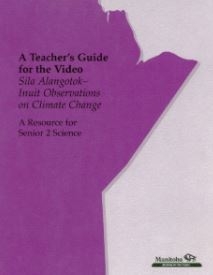
A Teacher's Guide for the Video Sila Alangotok - Inuit Observations on Climate Change
Secondary, Middle
Description
Sila Alangotok- Inuit Observations on Climate Change is a teacher’s guide to the video of the same name that chronicles the work of Canadian researchers who spent a year in Sach’s Harbour learning about the effects of climate change from the Inuit people. The guide helps students explore climate change issues raised in the video including the value of traditional ecological knowledge (TEK) in understanding climate change. While the video is not an essential component of this resource, its use is highly recommended.
The teacher’s guide consists of background information on climate change and TEK, eight suggested learning activities and a comprehensive set of resource materials that includes blackline masters, supplementary articles and a bibliography. Students are not expected to complete all eight activities. Teachers should select those activities that are most appropriate for their students. The activities include:
A. Activating Prior Knowledge. Students read an Environment Canada bulletin on the role of TEK in environmental management, watch the video and answer a series of questions. These questions emphasize the value of traditional knowledge in describing the effects of climate change in the Arctic and highlight individual actions that can be taken to address the problem.
B. Concept Map and Debate. Students view the video, chart climate change observations made by local residents and create a concept map that summarizes the ways in which climate change is affecting life in northern Canada. Students are then divided into two groups to debate the value of traditional knowledge in the study of global climate change.
C. Trip Reports Jigsaw. After watching the video, students form ‘home groups’ to review the evidence of climate change in the Arctic and the role played by traditional knowledge in documenting its effects. Students then form ‘expert groups’ and read detailed reports on four different components of the Sach’s Harbour study to evaluate the effectiveness of the various research methods used by the scientists.
D. The Impact of Climate Change. Students view the video and record observations on climate change made by community members and Inuit elders. These findings are then compared in chart form with the results of a scientific study carried out by Environment Canada researchers that students read and analyze. The activity concludes by having students answer a series of questions to summarize the similarities and differences between the two approaches and the importance of including both in the study of climate change.
E. Examining the Environmental, Economic and Social Consequences of Climate Change in the North. After brainstorming possible effects of climate change for northern communities, students view the video and add any additional social, economic and environmental consequences to their list. Working in small groups the students prepare a poster, poem, song (rap), illustration or article to present their findings to the rest of the class.
F. The Arctic Ecosystem and Climate Change Observations. Working in groups, each student selects a different Arctic plant or animal, researches its habitat using Environment Canada’s website and hypothesizes about how climate change might impact the species. Students then view the video and record any observations scientists and community members make about the species they have selected. With the information collected, each group creates a food web composed of the each member’s species and presents it to the class in the form of a poster.
G. Development Project: A Decision-Making Activity. Students take on the roles of various stakeholders in a northern community that has been targeted by a large oil and gas company for a major drilling project. After researching the perspectives that they are representing and preparing arguments students participate in a ‘town-hall meeting’ to decide on a course of action.
H. Creating a Community Plan to Reduce Greenhouse Gas Emissions. Students view the video and record the effects of climate change on the local community. After reviewing the causes and effects of climate change, students determine what measures their own community has taken in reducing greenhouse gas emissions. Students then brainstorm other steps their community could take to combat climate change and to develop a community action plan for implementing these initiatives.
General Assessment
What skills does this resource explicitly teach?
Students are required to practice/demonstrate the following skills.
- Decision-making
- Building consensus
- Concept mapping
- Debating
- Oral presentation
- Creating an action plan
Resources for teaching this skills are identified.
Strengths
- The resource does an excellent job in demonstrating the value and importance of traditional knowledge.
- The video does an excellent job in demonstrating how science and TEK can work together.
- The video does an excellent job in engaging students in the discussion of TEK and climate change.
- The video does an excellent job in promoting respect for aboriginal people and their traditions.
- The resource offers a wide range of interesting learning activities for students including role play, debate and action projects.
- The resource is thorough and easy to use. It includes easily reproduced blackline masters, question exercises with answers and suggestions for assessment.
- The resource begins with an excellent introduction to both climate change and TEK and concludes with an extensive bibliography of resources.
- Additional support for teachers and students is available from the Intenational Institute for Sustainable Development's website.
Weaknesses
- The resource does not include an out-of-doors component.
- Added structure and support are needed to help student action projects impact the community.
- The chronology of events relating to national and global climate change action is dated.
- Frequently cited teacher resources must be purchased.
Relevant Curriculum Units
The following tool will allow you to explore the relevant curriculum matches for this resource. To start, select a province listed below.
- Step 1Select a province
- Alberta
- Step 2Select a grade level
- Grade 6
- Step 3Select a subject
- Science
- Step 4Relevant matches
- Earth Systems: Understandings of the living world, Earth, and space are deepened through investigating natural systems and their interactions.
- Grade 9
- Step 3Select a subject
- Environmental Science
- Step 4Relevant matches
- Environment and Outdoor Education: Commitment to Action
- Environment and Outdoor Education: Environmental Investigations
- Science
- Step 4Relevant matches
- Environmental Chemistry
- Grade 11
- Step 3Select a subject
- Technological Education
- Step 4Relevant matches
- Wildlife - WLD2090:Issues in Wildlife
- Grade 12
- Step 3Select a subject
- Technological Education
- Step 4Relevant matches
- WLD3090: Analyzing Issues in Wildlife 2
- British Columbia
- Step 2Select a grade level
- Grade 7
- Step 3Select a subject
- Science
- Step 4Relevant matches
- Science 7: Earth and its climate have changed over geological time
- Grade 9
- Step 3Select a subject
- Science
- Step 4Relevant matches
- Science 9: The biosphere, geosphere, hydrosphere, and atmosphere are interconnected, as matter cycles and energy flows through them.
- Grade 10
- Step 3Select a subject
- Arts
- Step 4Relevant matches
- Media Arts 10: Traditions, perspectives, worldviews, and stories can be shared through media arts.
- English/Language Arts
- Step 4Relevant matches
- English First Peoples - Literary Studies: First Peoples texts and stories provide insight into key aspects of Canada’s past, present, and future
- English First Peoples - Literary Studies: The exploration of text and story deepens understanding of one’s identity, others, and the world.
- English First Peoples - New Media: The exploration of text and story deepens understanding of one’s identity, others, and the world
- Grade 11
- Step 3Select a subject
- Arts
- Step 4Relevant matches
- Media Arts 11: Media arts provide a unique way to represent self, identity, and culture
- Media Arts 11: Media arts reflect the interconnectedness of the individual, community, history, and society.
- English/Language Arts
- Step 4Relevant matches
- English First Peoples - Literary Studies + Writing: The exploration of text deepens understanding of one’s identity, others, and the world.
- English First Peoples - Literary Studies +New Media: First Peoples texts and stories provide insight into key aspects of Canada’s past, present, and future
- English First Peoples - Literary Studies: The exploration of text and story deepens understanding of one’s identity, others, and the world.
- Science
- Step 4Relevant matches
- Earth Science 11: The transfer of energy through the atmosphere creates weather and is affected by climate change
- Science for Citizenship 11: Scientific understanding enables humans to respond and adapt to changes locally and globally
- Grade 12
- Step 3Select a subject
- Arts
- Step 4Relevant matches
- Media Arts 12: Media arts are an essential element of culture and reveal insights into the human experience
- English/Language Arts
- Step 4Relevant matches
- English First Peoples 12: The exploration of text and story deepens understanding of one’s identity, others, and the world.
- English First Peoples 12:First Peoples texts and stories provide insight into key aspects of Canada’s past, present, and future
- English First Persons 12: Oral and other texts are socially, culturally, geographically, and historically constructed.
- Environmental Science
- Step 4Relevant matches
- Environmental Science 12: Human activities cause changes in the global climate system
- Science
- Step 4Relevant matches
- Specialized Science 12: Climate change impacts biodiversity and ecosystem health
- Social Studies
- Step 4Relevant matches
- B.C. First Peoples: The identities, worldviews, and languages of B.C. First Peoples are renewed, sustained, and transformed through their connection to the land
- Contemporary Indigenous Studies: The identities, worldviews, and languages of indigenous peoples are renewed, sustained, and transformed through their connection to the land.
- Physical Geography 12: Interactions between human activities and the atmosphere affect local and global weather and climate
- Manitoba
- Step 2Select a grade level
- Grade 10
- Step 3Select a subject
- Science
- Step 4Relevant matches
- Life Systems
- Senior 2 Science: Dynamics of Ecosystems
- Senior 2 Science: Weather Dynamics
- Grade 11
- Step 3Select a subject
- Science
- Step 4Relevant matches
- Current Topics in the Sciences 30S: Science, Technology, Society & the Environment
- New Brunswick
- Step 2Select a grade level
- Grade 11
- Step 3Select a subject
- Biology
- Step 4Relevant matches
- Biology 111/2: Study of Life
- Grade 12
- Step 3Select a subject
- Environmental Science
- Step 4Relevant matches
- Introduction to Environmental Science 120: Investigating Environmental Issues
- Newfoundland & Labrador
- Step 2Select a grade level
- Grade 10
- Step 3Select a subject
- Science
- Step 4Relevant matches
- Science 1206: Sustainability of Ecosystems
- Grade 11
- Grade 12
- Step 3Select a subject
- Environmental Science
- Step 4Relevant matches
- Environmental Science 3205: The Atmosphere and the Environment
- Geography
- Step 4Relevant matches
- World Geography 3200/3202: Ecosystems
- Northwest Territories
- Step 2Select a grade level
- Grade 7
- Step 3Select a subject
- Science
- Step 4Relevant matches
- Science 7: Earth and its climate have changed over geological time
- Grade 9
- Step 3Select a subject
- Science
- Step 4Relevant matches
- Science 9: The biosphere, geosphere, hydrosphere, and atmosphere are interconnected, as matter cycles and energy flows through them.
- Grade 10
- Step 3Select a subject
- Arts
- Step 4Relevant matches
- Media Arts 10: Traditions, perspectives, worldviews, and stories can be shared through media arts.
- English/Language Arts
- Step 4Relevant matches
- English First Peoples - Literary Studies: First Peoples texts and stories provide insight into key aspects of Canada’s past, present, and future
- English First Peoples - Literary Studies: The exploration of text and story deepens understanding of one’s identity, others, and the world.
- English First Peoples - New Media: The exploration of text and story deepens understanding of one’s identity, others, and the world
- Grade 11
- Step 3Select a subject
- Arts
- Step 4Relevant matches
- Media Arts 11: Media arts provide a unique way to represent self, identity, and culture
- Media Arts 11: Media arts reflect the interconnectedness of the individual, community, history, and society.
- English/Language Arts
- Step 4Relevant matches
- English First Peoples - Literary Studies + Writing: The exploration of text deepens understanding of one’s identity, others, and the world.
- English First Peoples - Literary Studies +New Media: First Peoples texts and stories provide insight into key aspects of Canada’s past, present, and future
- English First Peoples - Literary Studies: The exploration of text and story deepens understanding of one’s identity, others, and the world.
- Science
- Step 4Relevant matches
- Earth Science 11: The transfer of energy through the atmosphere creates weather and is affected by climate change
- Science for Citizenship 11: Scientific understanding enables humans to respond and adapt to changes locally and globally
- Grade 12
- Step 3Select a subject
- English/Language Arts
- Step 4Relevant matches
- English First Peoples 12: The exploration of text and story deepens understanding of one’s identity, others, and the world.
- English First Peoples 12:First Peoples texts and stories provide insight into key aspects of Canada’s past, present, and future
- English First Persons 12: Oral and other texts are socially, culturally, geographically, and historically constructed.
- Environmental Science
- Step 4Relevant matches
- Environmental Science 12: Human activities cause changes in the global climate system
- Science
- Step 4Relevant matches
- Specialized Science 12: Climate change impacts biodiversity and ecosystem health
- Nova Scotia
- Nunavut
- Step 2Select a grade level
- Grade 10
- Step 3Select a subject
- Indigenous Languages and Cultures
- Step 4Relevant matches
- Relationship to the Environment
- Grade 11
- Step 3Select a subject
- Biology
- Step 4Relevant matches
- Biology 20: Ecosystems and Population Change
- Grade 12
- Step 3Select a subject
- Environmental Studies
- Step 4Relevant matches
- Environmental Studies 35: Northern Climate
- Environmental Studies 35: Northern Environmental Issues
- Ontario
- Step 2Select a grade level
- Grade 9
- Grade 11
- Step 3Select a subject
- Geography
- Step 4Relevant matches
- Forces of Nature: Physical Processes and Disasters (Univ./College Prep.): The Physical Environment: Sustainability and Stewardship
- Regional Geography (Univ./College Prep.): Sustainability and Stewardship
- Indigenous Studies
- Step 4Relevant matches
- Contemporary First Nations, Métis, and Inuit Issues and Perspectives (univ./college prep.) Cultural Identity and Cultural Continuity
- Grade 12
- Step 3Select a subject
- Geography
- Step 4Relevant matches
- The Environment & Resource Management (Univ./College Prep) : Ecological Systems: Interactions and Interdependence
- The Environment & Resource Management (Univ./College Prep.):Sustainability and Stewardship of Natural Resources
- The Environment & Resource Management (Workplace Preparation): Human-Environment Interactions
- Indigenous Studies
- Step 4Relevant matches
- Contemporary Indigenous Issues and Perspectives in a Global Context, (Univ./College prep.): Global Trends and Cultural Survival
- Prince Edward Island
- Quebec
- Step 2Select a grade level
- Grade 10
- Step 3Select a subject
- Science & Technology
- Step 4Relevant matches
- Applied Science & Technology:The Living World
- Environmental Science & Technology: The Living World
- Science & Technology:The Living World
- Science and the Environment: The Living World
- Saskatchewan
- Step 2Select a grade level
- Grade 10
- Step 3Select a subject
- Indigenous Studies
- Step 4Relevant matches
- Native Studies 10: Community and Kinship: Aboriginal Perspectives
- Science
- Step 4Relevant matches
- Science 10: Climate and Ecosystem Dynamics
- Grade 11
- Step 3Select a subject
- Social Studies
- Step 4Relevant matches
- Social Studiees 20:World Issues - Environment
- Yukon Territory
- Step 2Select a grade level
- Grade 7
- Step 3Select a subject
- Science
- Step 4Relevant matches
- Science 7: Earth and its climate have changed over geological time
- Grade 9
- Step 3Select a subject
- Science
- Step 4Relevant matches
- Science 9: The biosphere, geosphere, hydrosphere, and atmosphere are interconnected, as matter cycles and energy flows through them.
- Grade 10
- Step 3Select a subject
- Arts
- Step 4Relevant matches
- Media Arts 10: Traditions, perspectives, worldviews, and stories can be shared through media arts.
- English/Language Arts
- Step 4Relevant matches
- English First Peoples - Literary Studies: First Peoples texts and stories provide insight into key aspects of Canada’s past, present, and future
- English First Peoples - Literary Studies: The exploration of text and story deepens understanding of one’s identity, others, and the world.
- English First Peoples - New Media: The exploration of text and story deepens understanding of one’s identity, others, and the world
- Grade 11
- Step 3Select a subject
- Arts
- Step 4Relevant matches
- Media Arts 11: Media arts provide a unique way to represent self, identity, and culture
- Media Arts 11: Media arts reflect the interconnectedness of the individual, community, history, and society.
- English/Language Arts
- Step 4Relevant matches
- English First Peoples - Literary Studies + Writing: The exploration of text deepens understanding of one’s identity, others, and the world.
- English First Peoples - Literary Studies +New Media: First Peoples texts and stories provide insight into key aspects of Canada’s past, present, and future
- English First Peoples - Literary Studies: The exploration of text and story deepens understanding of one’s identity, others, and the world.
- Science
- Step 4Relevant matches
- Earth Science 11: The transfer of energy through the atmosphere creates weather and is affected by climate change
- Science for Citizenship 11: Scientific understanding enables humans to respond and adapt to changes locally and globally
- Grade 12
- Step 3Select a subject
- Arts
- Step 4Relevant matches
- Media Arts 12: Media arts are an essential element of culture and reveal insights into the human experience
- English/Language Arts
- Step 4Relevant matches
- English First Peoples 12: The exploration of text and story deepens understanding of one’s identity, others, and the world.
- English First Peoples 12:First Peoples texts and stories provide insight into key aspects of Canada’s past, present, and future
- English First Persons 12: Oral and other texts are socially, culturally, geographically, and historically constructed.
- Environmental Science
- Step 4Relevant matches
- Environmental Science 12: Human activities cause changes in the global climate system
- Science
- Step 4Relevant matches
- Specialized Science 12: Climate change impacts biodiversity and ecosystem health
- Social Studies
- Step 4Relevant matches
- B.C. First Peoples: The identities, worldviews, and languages of B.C. First Peoples are renewed, sustained, and transformed through their connection to the land
- Contemporary Indigenous Studies: The identities, worldviews, and languages of indigenous peoples are renewed, sustained, and transformed through their connection to the land.
- Physical Geography 12: Interactions between human activities and the atmosphere affect local and global weather and climate
Themes Addressed
Air, Atmosphere & Climate (1)
- Climate Change
Ecosystems (2)
- Appreciating the Natural World
- Habitat Loss
Indigenous Knowledge (1)
- TEK -- Traditional Ecological Knowledge
Sustainability Education Principles
| Principle | Rating | Explanation |
|---|---|---|
| Consideration of Alternative Perspectives | Good | The resource does an excellent job in incorporating the strengths and limitations of both TEK and scientific investigation. |
Consideration of Alternative Perspectives:
| ||
| Multiple Dimensions of Problems & Solutions | Good | Students consider environmental, social and economic dimensions of climate change. |
| Multiple Dimensions of Problems & Solutions: Effectively addresses the environmental, economic and social dimensions of the issue(s) being explored.
| ||
| Respects Complexity | Good | |
| Respects Complexity: The complexity of the problems/issues being discussed is respected. | ||
| Acting on Learning | Satisfactory | One activity asks students to develop an instrument to document climate change observations from within their own communities but offers little support. Another activity helps students develop a community action plan to fight climate change. |
| Acting on Learning: Learning moves from understanding issues to working towards positive change — in personal lifestyle, in school, in the community, or for the planet
| ||
| Values Education | Good | Activities within the resource
|
| Values Education: Students are explicitly provided with opportunities to identify, clarify and express their own beliefs/values. | ||
| Empathy & Respect for Humans | Very Good | |
| Empathy & Respect for Humans: Empathy and respect are fostered for diverse groups of humans (including different genders, ethnic groups, sexual preferences, etc.). | ||
| Personal Affinity with Earth | Satisfactory | There is potential for out-of-doors experience but it is not put into practice. |
| Personal Affinity with Earth: Encourages a personal affinity with -the natural world.
| ||
| Locally-Focused Learning | Good | This would be especially applicable to the use of this resource in northern communities. Some effort is made through activities that involve role play, debate and action experience to make the learning relevant to students in the rest of Canada as well. |
| Locally-Focused Learning: Includes learning experiences that take advantage of issues/elements within the local community.
| ||
| Past, Present & Future | Very Good | |
| Past, Present & Future: Promotes an understanding of the past, a sense of the present, and a positive vision for the future. | ||
Pedagogical Approaches
| Principle | Rating | Explanation |
|---|---|---|
| Open-Ended Instruction | Good | |
| Open-Ended Instruction
: Lessons are structured so that multiple/complex answers are possible; students are not steered toward one 'right' answer. | ||
| Integrated Learning | Good | |
| Integrated Learning: Learning brings together content and skills from more than one subject area
| ||
| Inquiry Learning | Satisfactory | |
| Inquiry Learning: Learning is directed by questions, problems, or challenges that students work to address.
| ||
| Differentiated Instruction | Good | |
| Differentiated Instruction: Activities address a range of student learning styles, abilities and readiness.
| ||
| Experiential Learning | Satisfactory | |
| Experiential Learning: Authentic learning experiences are provided
| ||
| Cooperative Learning | Good | |
| Cooperative Learning: Group and cooperative learning strategies are a priority.
| ||
| Assessment & Evaluation | Good | |
| Assessment & Evaluation: Tools are provided that help students and teachers to capture formative and summative information about students' learning and performance. These tools may include reflection questions, checklists, rubrics, etc. | ||
| Peer Teaching | Satisfactory | |
| Peer Teaching: Provides opportunities for students to actively present their knowledge and skills to peers and/or act as teachers and mentors.
| ||
| Case Studies | Very Good | |
| Case Studies: Relevant case studies are included. Case studies are thorough descriptions of real events from real situations that students use to explore concepts in an authentic context. | ||
| Locus of Control | Satisfactory | Two activities encourage students to choose the medium in which to work. Some control over content/topic two of the activities is given to students |
| Locus of Control: Meaningful opportunities are provided for students to choose elements of program content, the medium in which they wish to work, and/or to go deeper into a chosen issue. | ||